Before You Buy: How to Read a CBD Certificate of Analysis Without the Jargon
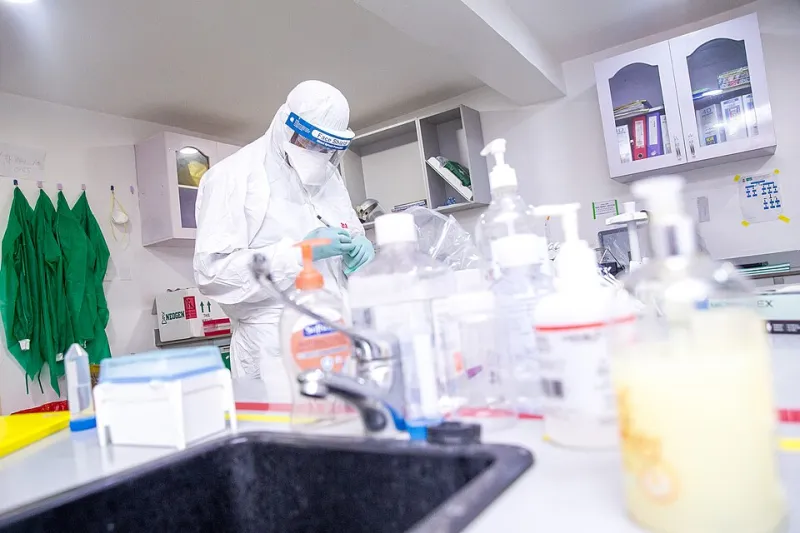
Photo: Rubbyfem, CC BY-SA 4.0, via Wikimedia Commons
British shoppers have become reasonably good at reading food labels. We know that a traffic-light system means something, that 'made with real fruit' is not a nutritional claim, and that a supermarket's own 'farm assured' badge is worth roughly the paper it is printed on. CBD labelling has not yet reached that level of public literacy, and the industry has no incentive to accelerate it.
Our position at Med & Mar Health is straightforward: a CBD product sold to consumers should be able to demonstrate, batch by batch, what is inside it. Not a brand-level promise. Not a badge. A document with a number on it that matches the number on your bottle.
What a certificate of analysis actually is
A certificate of analysis — usually shortened to COA — is a laboratory report describing the contents of a specific sample. A credible one will state which laboratory performed the work, the date the sample was received and tested, the batch or lot number, and the analytical methods used.
The best reports come from laboratories accredited to ISO/IEC 17025, which is the international standard for testing competence. That accreditation is not a guarantee of quality in the product, but it is a guarantee that the testing was done to a recognised standard by a lab whose methods have been independently assessed.
What a COA is not: a marketing asset. It is a snapshot of one batch. It tells you nothing about the batch you bought unless the numbers match.
The five checks worth doing every time
One: does the batch number match? This is the single most common failure. Brands frequently publish a single, years-old certificate as evidence of general goodness. Look for the lot code on the base of your bottle or on the batch sticker, and compare it character by character. If the certificate has no batch number at all, treat it as decoration.
Two: who did the testing? A named laboratory with a website and an accreditation number is meaningful. 'Independently lab tested' printed on a product page, with no report linked, is not.
Three: how recent is it? A certificate from 2023 tells you about a batch that has long since sold through. Freshness matters, particularly for cannabinoid content, which can drift during storage.
Four: what was measured? A minimum panel covers the full cannabinoid profile — CBD, CBDA, THC, THCA, CBG and others — plus heavy metals (lead, cadmium, arsenic, mercury), pesticides, residual solvents, mycotoxins, and microbial contamination. A report that lists only CBD percentage is a partial picture at best.
Five: what are the limits of detection? Good reports state the limit of detection and limit of quantification for each analyte. 'THC not detected' is reassuring only when you know the threshold. A result reported as below 0.01% is meaningfully different from an untested blank field.
Doing the arithmetic the label hides
Labels are written to sound impressive rather than to inform. A bottle marked '10% CBD' contains roughly 100mg per millilitre; in a 10ml bottle that is 1000mg in total. If a single drop is 0.05ml, one drop delivers about 5mg. That means the Food Standards Agency's precautionary ceiling of 10mg per day for healthy adults is reached at two drops — not two droppers.
This calculation is not a recommendation. It is an illustration of how easily a beginner can overshoot while believing they are following the label. Convert every product to milligrams per drop before you compare it with anything else, and remember that cannabis extract weights and carrier oil volumes are not the same thing.
Common tricks, plainly described
- The orphan certificate. A beautiful PDF, no batch number, no link to your purchase.
- The white-label report. A lab report for a formulation the brand buys in, presented as though it were testing of the finished retail product.
- 'Full spectrum' as a personality trait. It describes a type of extract, not a quality grade. Without a cannabinoid panel it is an unverified adjective.
- 'THC-free' without a result. In practice, trace THC is often present below a stated threshold. Ask for the figure.
- Subscription-shaped urgency. Discounts contingent on an annual commitment deserve a second reading, particularly where cancellation terms are buried.
- Borrowed science. A citation to a 2011 laboratory study does not describe the bottle in your hand.
Comparing two products fairly
Take the total milligrams of CBD, divide by the number of drops or servings the manufacturer states, and compare cost per milligram alongside the strength of the batch evidence. A cheaper product with a verifiable certificate and a clear cannabinoid panel is usually the better buy than a premium one with a fog of wellness language around it. Check the FSA's public list of products attached to valid novel food applications, and treat any brand that cannot produce batch-level documentation as a brand making a claim it cannot support.
The bottom line
Scepticism is not cynicism. It is simply the reasonable position for a consumer buying an unlicensed product in a lightly regulated category. Ask for the batch number, the laboratory, the date and the panel. If a company cannot supply them promptly, that is your answer — and you have saved yourself both the money and the guesswork.